
Research
Collaborative and Interdisciplinary Research
The Electrical and Computer Engineering department nourishes a vibrant research environment motivated by our dedicated faculty and graduate students. Our research programs are funded by many government agencies, including the National Science Foundation (NSF), the National Institute of Health (NIH), the Office of Naval Research (ONR), the Air Force Office of Scientific Research (AFOSR), Defense Advanced Research Projects Agency (DARPA), Department of Homeland Security, and numerous local and national industries.
Research activities at the ECE Department can be classified by research areas and by research centers and institutes. The department offers eight research areas of focus and is either the lead or partner of nine research centers and institutes.
Faculty also conduct research in their labs. View faculty profiles to learn about their research, including work being conducted in their laboratories. Also, view our Annual Reports and college-wide Research Initiatives.
Quick Facts
external research awards (2023)
tenured/tenure-track faculty
research centers and institutes (leading or affiliated with)
Research Strengths
Our research strengths encompass the full gamut of cutting-edge ECE technologies: embedded systems and internet-of-things, robotics and cyber-human systems, networking (mobile/wireless as well as the Internet of the future), big data analytics and machine learning. Northeastern’s historic strengths in ECE include communications and digital signal processing, power and control systems, power electronics, RF/microwave magnetic materials, device technologies, and computer engineering.
Biomedical Research and Collaborations
Northeastern ECE faculty are engaged in a range of biomedical projects in collaboration with fellow world-class researchers in the Boston-area medical community. These projects span all disciplinary areas and include MEMS/NEMS sensors for biological detection; applications of wireless technology in biomedical implants; biomedical imaging hardware and signal processing; brain-computer interface technologies; disease detection and tracking; and many more.
Recent News
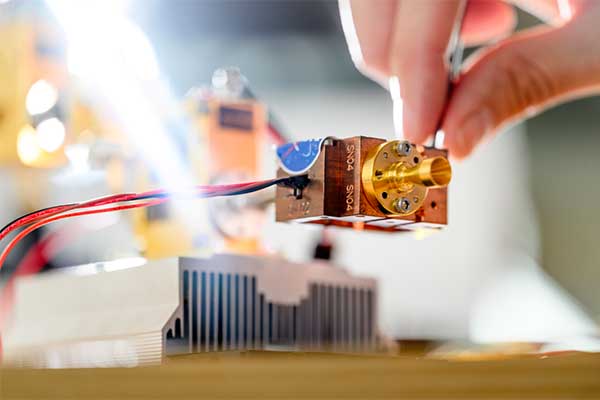
Developing Worldwide High-Speed Internet Access via Satellite
A group of COE faculty led by ECE Professor and Interim Chair Josep Jornet is partnering with student group Project Horizon and Morehead State University to develop what could be the world’s first sub-THz wireless satellite network testbed.
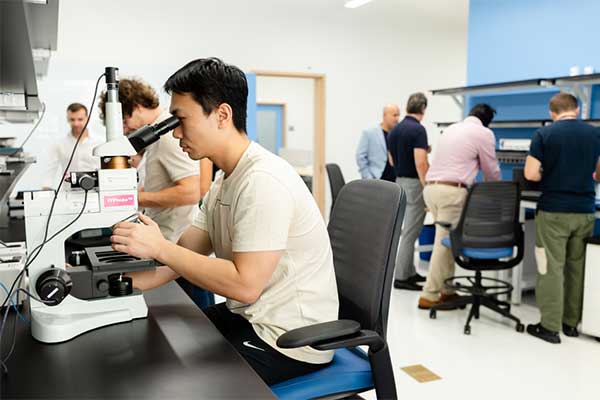
Advancing Northeastern’s Bicoastal Mission To Develop Next-Generation Silicon Chips
The Institute for NanoSystems Innovation, led by ECE Professors Matteo Rinaldi and David Horsley as director and deputy director, respectively, is growing its bicoastal initiative to pioneer advanced semiconductor design by collaborating with faculty, industry, and graduate students from the Boston and Oakland campuses.
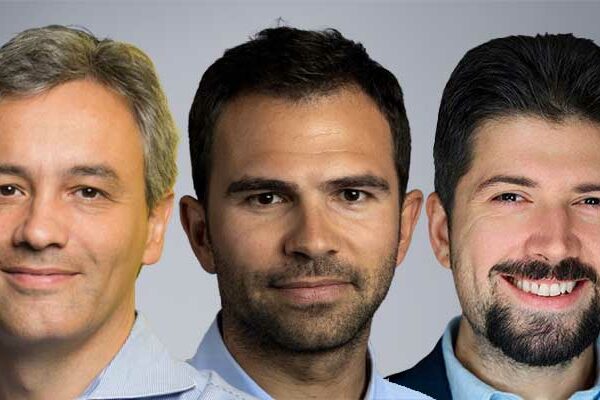
Patent for Protecting Private Data on 5G Networks
ECE William Lincoln Smith Professor Tommaso Melodia, Associate Research Professor Salvatore D’Oro, and Assistant Professor Francesco Restuccia were awarded a patent for “Private 5G cellular connectivity as a service through full-stack wireless steganography.”

Tool To Assess Vocal Communication in Minimally-Speaking Individuals
Kristina Johnson, ECE/Bouvé assistant professor, received a $700,000 NIH Career Development Award for “Using Mobile Technology and Real-World Vocalization Samples To Generate Quantitative Metrics of Vocal Communication for Minimally-Speaking Individuals.”