Improving Quantum Computing Reliability and Scalability Through Modular Error Correction
ECE Associate Professor Hessam Mahdavifar and COS/ECE Assistant Professor Ivana Dimitrova were awarded a DOE grant for “Hierarchically Coupled Quantum LDPC Codes for Modular Quantum Computing.”
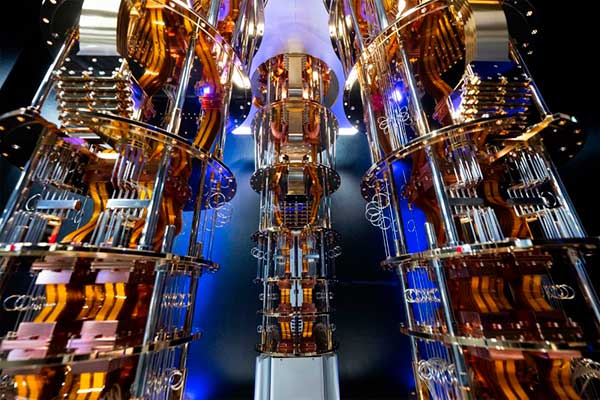
This article originally appeared on Northeastern Global News. It was published by Cesareo Contreras. Main photo: A model of a suspension of the quantum chip of a Quantum System Two quantum computer. Photo by: Marijan Murat/picture-alliance/dpa/AP Images
These researchers seek to quiet ‘the noise’ in quantum computing
These Northeastern University researchers are working to make quantum computers more efficient.
Quantum computers are poised to transform the world – enabling everything from advancements in drug discovery and material science to breakthroughs in supply chain routing and financial risk modeling.
Yet the cutting edge technology is fragile and can be difficult to deploy, explained Ivana Dimitrova, a professor of physics and electrical engineering at Northeastern University.
That’s partly because a single quantum computing machine today is too “ small and noisy” to process the hundreds of thousands of qubits — the units of information built from individual particles such as atoms, ions and photons — that power these machines to solve real challenges, Dimitrova, said.
One solution is linking quantum computing processors together to share their power in a process known as modular quantum computing. It’s a model that’s taken the quantum computing industry by storm in recent years, Dimitrova said, but it is similarly plagued with its own computational challenges. For instance, the links between the processors can be slow and have their own data interference issues.
 |  |
Hessam Mahdavifar and Ivana Dimitrova are working together on making modular quantum computing systems less error prone. Photos by Matthew Modoono/Northeastern University
Now, with support from the U.S. Department of Energy, Dimitrova and Hessam Mahdavifar, a Northeastern electrical and computer engineering professor, will spend the next two years working to address those issues head on by developing algorithms to make modular quantum computing systems more reliable.
For the two-year project, the team will look to reduce the impact of noise — errors and unwanted interference — that occurs in the physical links that connect quantum computing machines together as well as in the quantum computing processors themselves.
Read full story at Northeastern Global News